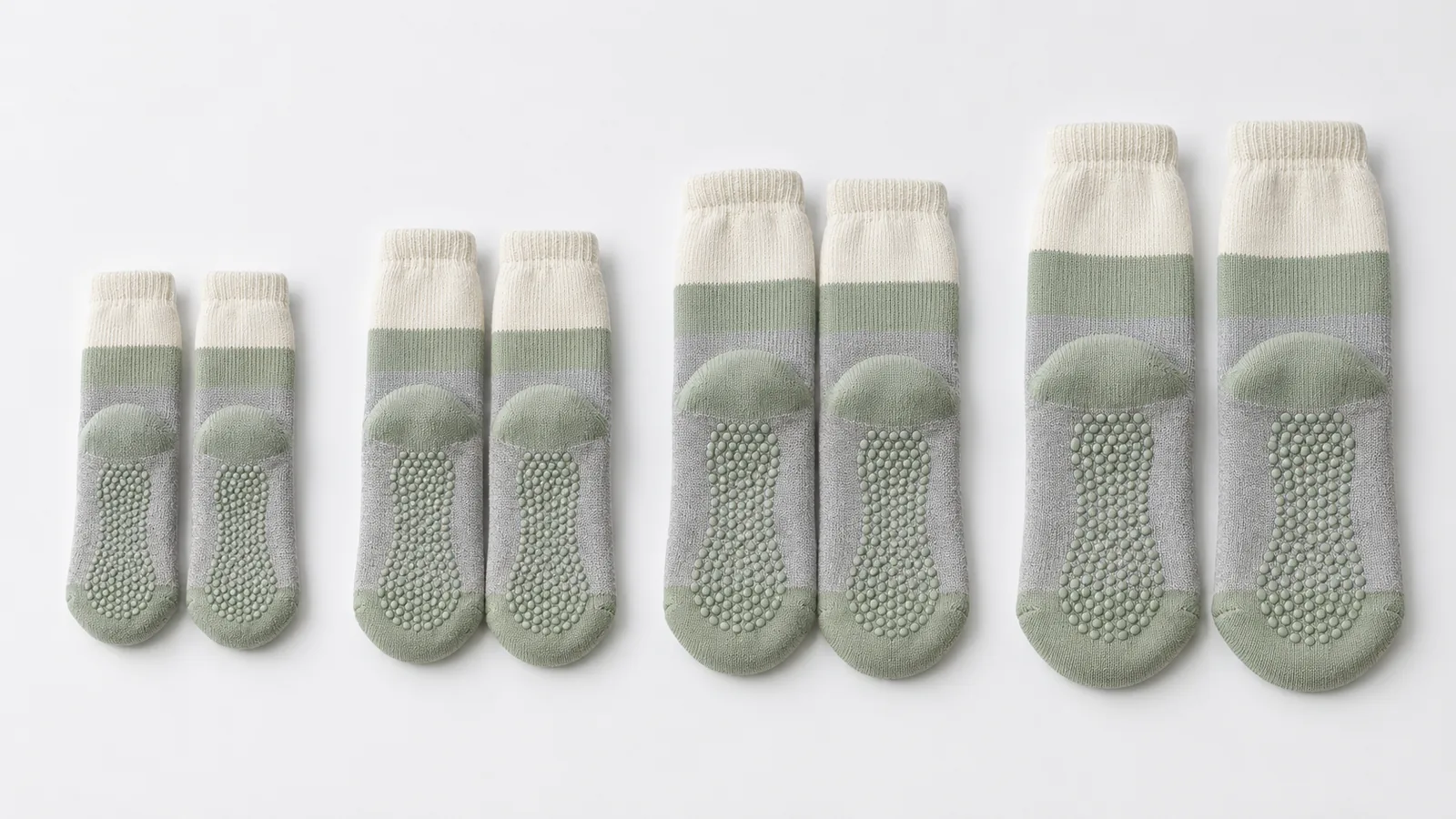
One-size grip socks can simplify stock planning, but the stated range still needs to fit the intended users. A measured multi-size range can improve heel placement, reduce bunching and keep the grip pattern closer to the loaded areas of the foot. The right number of sizes depends on the buyer group, sales channel and fit trials.
Sizing deserves the same attention as grip material and logo method. A grip sock works best when raised elements remain under the intended contact zones. Stretch the sock too far and those elements move; leave excess fabric and they may fold or rotate away from the expected position.
This guide explains what can happen when a grip sock is outside its intended fit range, how to measure and choose for yourself, and how to structure a size brief for a custom grip sock program.
Why Sizing Changes Grip Performance
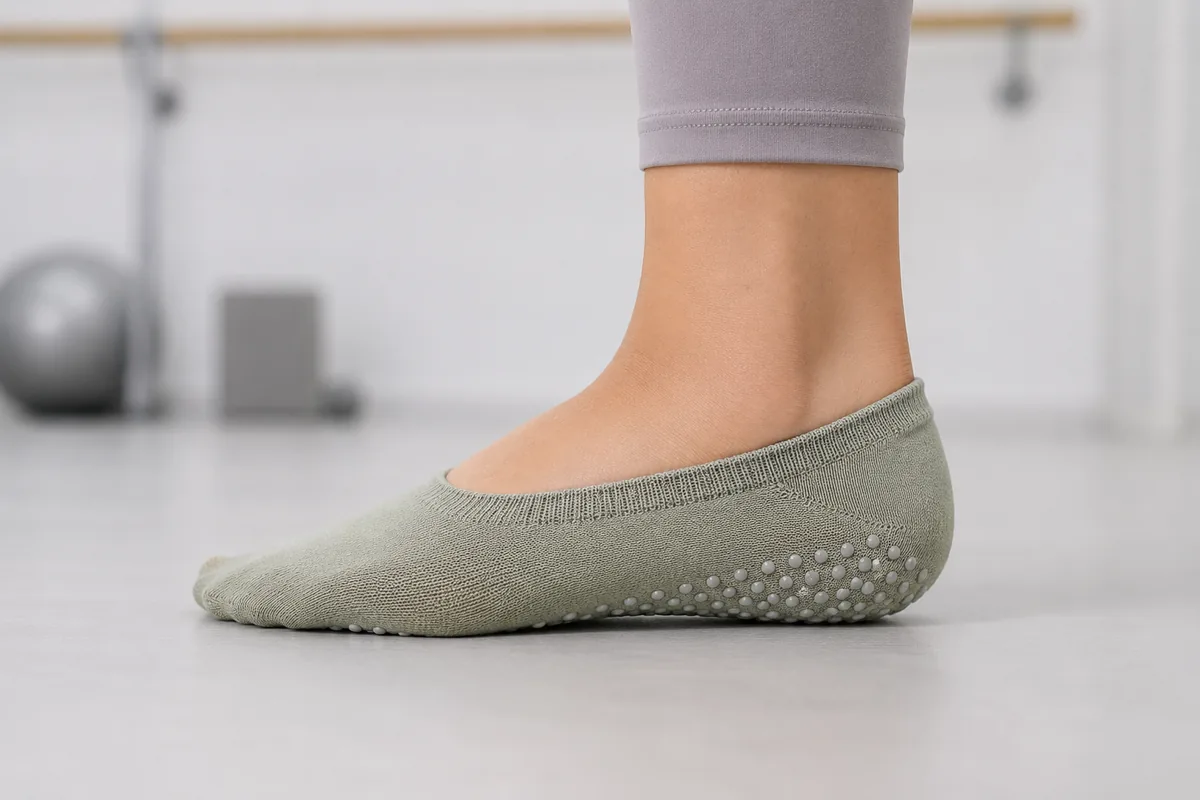
Think of the sole of a grip sock as a map. The grip pattern is positioned to sit under the ball of the foot, the heel and the outer edge — the areas that carry load and where slipping starts.
Now stretch that sock onto a foot two sizes too large. The whole map stretches with it. The pattern that was designed to sit under the ball of the foot now sits behind it, in the arch, where there is much less pressure. You still have grip on the sock, but it is no longer under the part of the foot that needs it. On a reformer footbar or a smooth studio floor, that is the difference between holding a position and sliding.
The opposite failure is just as real. A sock that is too large bunches under the arch and at the toe, creating folds. Folded grip does not contact the surface flatly, and the loose fabric lets the whole sock rotate on the foot during movement — so even correctly positioned grip ends up somewhere else mid-session.
There is a secondary effect too. Over-stretched fabric pulls the grip elements apart and puts continuous tension on the bond between grip and knit. That does not help long-term adhesion, particularly at the edges of each element.
The Real Case for One Size
One size is not simply a shortcut, and it is worth stating its genuine advantages before dismissing it.
It is operationally simple: one SKU is easier to order, store, count and reorder, with no size-mix forecast. A single size can also reduce setup and finishing complexity, although the final project cost still depends on construction, grip, colors, branding, packaging and quantity. At a front desk or venue counter, fewer choices can make handout and point-of-sale handling faster.
For a genuinely narrow, measured user range it can be the right answer. The risk appears when one stated size is expected to cover users whose foot lengths and widths exceed what the construction can accommodate. That should be checked on real feet rather than assumed from a broad shoe-size label.
The Real Case for Multiple Sizes
Multiple sizes add setup, finishing and size-mix planning, but they let the buyer define narrower fit ranges.
A well-tested size range can keep the heel pocket and grip zones closer to their intended positions across more users. For retailers, clearer foot-length ranges may also reduce avoidable fit questions and exchanges, but the result depends on the accuracy of the chart, the product construction and how customers select a size.
The practical middle ground is usually found by grouping measured users into the fewest ranges that still meet the product's fit target. Do not choose the number before reviewing who will wear the socks.
Side-by-Side Comparison
| Factor | One size | Multiple sizes |
|---|---|---|
| Grip position accuracy | May drift near the limits of a broad range | Can stay closer to the intended position when fit-tested |
| Fit across the market | Depends on how broad the stated range is | Narrower ranges can improve consistency |
| Fit questions and exchanges | Can increase when the stated range is too broad | Clear measured ranges can reduce avoidable selection errors |
| Stock complexity | Simplest — one SKU | Requires size-mix forecasting |
| Production planning | One size and one quantity split | Additional setup, finishing and quantity splits |
| Point-of-sale friction | Lowest — no size decision | Needs a clear size chart |
| Best suited to | Narrow adult range, promo items, giveaways | Retail lines, studios, venues, family markets |
How to Choose Your Size as a Buyer
Sock sizing is less standardised than shoe sizing, so a shoe size alone is not always enough.
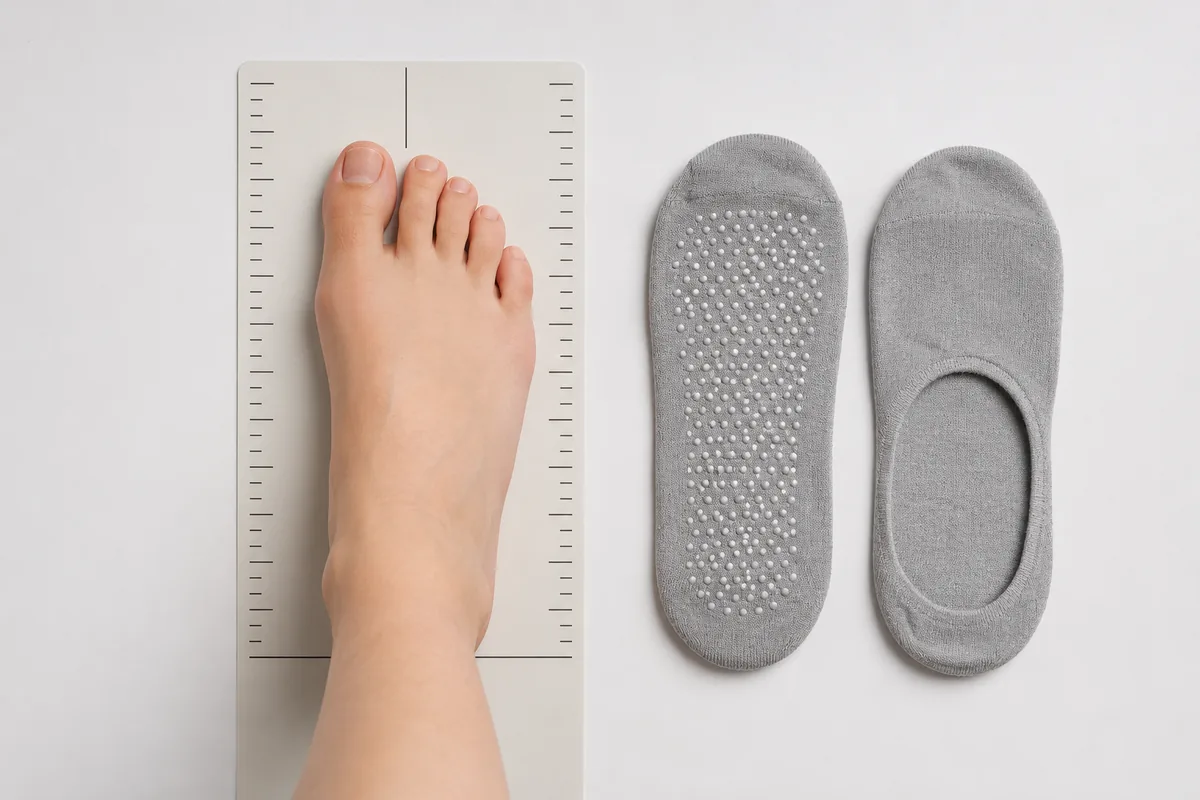
The most reliable method is to measure your foot length. Stand on a sheet of paper with your heel against a wall, mark the tip of your longest toe, and measure the distance in centimetres. Compare that measurement to the manufacturer's chart rather than relying on a shoe-size conversion, because conversions differ between brands and regions.
Then check the fit on the foot rather than in the hand. Three things tell you it is right: the heel pocket sits on your heel rather than below or above it, the grip pattern sits under the ball of your foot when you stand, and the cuff holds without digging in or leaving a deep mark. Left and right shaping is a separate question from size; the left and right sock guide explains the difference.
If you fall between sizes, use the finished product's own fit guidance rather than a universal size-up or size-down rule. A smaller size may hold position better, but it is not suitable if it compresses the toes or makes the cuff uncomfortably tight. The correct choice is the size that keeps the heel pocket and grip zones in place without excessive pressure.
If the foot length seems right but the cuff or instep feels restrictive, use the grip sock tightness and ankle-mark guide to separate size, cuff construction and care-related changes before selecting another size.
For a gym range with multiple heights, the knee-high versus crew sizing considerations explain why calf allowance, leg length and cuff position need review alongside the foot-size plan.
Structuring a Size Range for Wholesale Orders
If you are ordering for a business rather than yourself, the question becomes how many sizes and what mix.
Retail brands and online sellers
Fit-related exchanges can be costly, so begin with measured customer data rather than a preset number of sizes. Publish foot-length ranges as well as the relevant shoe-size equivalents, and state the fit intention so customers can select more accurately.
Pilates and yoga studios
Studios should compare their member size distribution with the selected sock construction. Because reformer and floor work depend on stable fit, review the smallest and largest proposed sizes through the Pilates and yoga grip sock program. To decide how members bring, buy or borrow pairs, see the studio sock policy guide.
Football clubs and academies
You are fitting a squad, and the sock is part of the boot fit, so sizing interacts with footwear. Build the range from player measurements and have users confirm the sample in their own boots. The football grip sock program shows the wider brief to prepare.
Trampoline parks and indoor venues
Guest ranges can span children and adults on the same day, so operators should compare measured demand before choosing the number of sizes. Color-coding the cuff can help staff sort a confirmed range. Review venue requirements through the trampoline park grip sock program.
What to Specify When You Order
Sizing is one of the specifications buyers describe most loosely and then get surprised by, so it is worth being explicit in your brief.
- Measured dimensions per size, not only shoe-size equivalents. Foot length range, sock length and cuff circumference give you something you can check on arrival.
- The target region. Shoe-size conventions differ between US, UK and EU markets, so state which system your published chart will use.
- The intended fit. Snug or relaxed changes the pattern. For grip socks, snug is generally better because it keeps the grip in position.
- Grip layout per size. Ask the supplier to confirm how the pattern is positioned across the proposed sizes and inspect the physical samples.
- Cuff specification per size, especially when the proposed range spans children and adults.
- Quantity split by size, so the factory can confirm project-specific feasibility and pricing.
The number of sizes can affect setup, finishing and quantity planning alongside material, grip coverage, pattern complexity, branding, packaging and total quantity. Record the size breakdown in the custom grip sock specification template, then compare the same written scope when reviewing a custom grip sock wholesale quote.
Sample across the range, not just the middle
Do not approve a mid-size sample and assume the rest of the range scales correctly. Where the project scope allows, review the smallest and largest proposed sizes on representative feet, then record dimensions, heel placement and grip position. Add these checkpoints to the sample and QC checklist and the approved specification.
Frequently Asked Questions
Do one size grip socks actually work?
They can work for a measured user group when the construction accommodates the stated range. A range that is too broad may stretch or bunch the sock and shift the grip pattern. Check the smallest and largest intended users before approval.
Should I size up or down in grip socks?
Follow the finished product's own chart and fit guidance. Choose the option that keeps the heel and grip zones in place without compressing the toes or making the cuff uncomfortably tight.
How do I measure my foot for grip socks?
Stand on paper with your heel against a wall, mark the tip of your longest toe and measure the distance in centimetres. Compare that to the manufacturer's chart. Foot length is more reliable than a shoe-size conversion, which varies by brand and region.
Does sock size affect how well grip socks work?
Yes, directly. The grip pattern is positioned to sit under the ball of the foot, heel and outer edge. If the sock is stretched or bunched, those elements move away from those areas, so you get less traction even though the grip itself is intact.
How many sizes should I offer if I sell grip socks?
There is no universal number. Use measured demand, the breadth of the target group, the sock construction and fit trials to define the fewest ranges that still fit the intended users. Publish foot-length ranges alongside the relevant shoe-size equivalents.
Does adding more sizes increase the cost per pair?
It can change setup, finishing and quantity planning, but the effect is project-specific. Compare the complete specification and size mix rather than assuming a fixed increase per pair.
Is the grip pattern the same on every size?
Do not assume it is identical or automatically scaled. Ask how the layout is positioned for each proposed size and verify the physical samples against the intended contact zones.
Planning a Grip Sock Size Range?
Send the intended activity, target users, market size references, quantity split, grip direction, logo and packaging requirement. We will review the practical size and sample scope before bulk production.
Request a Sample & Quote