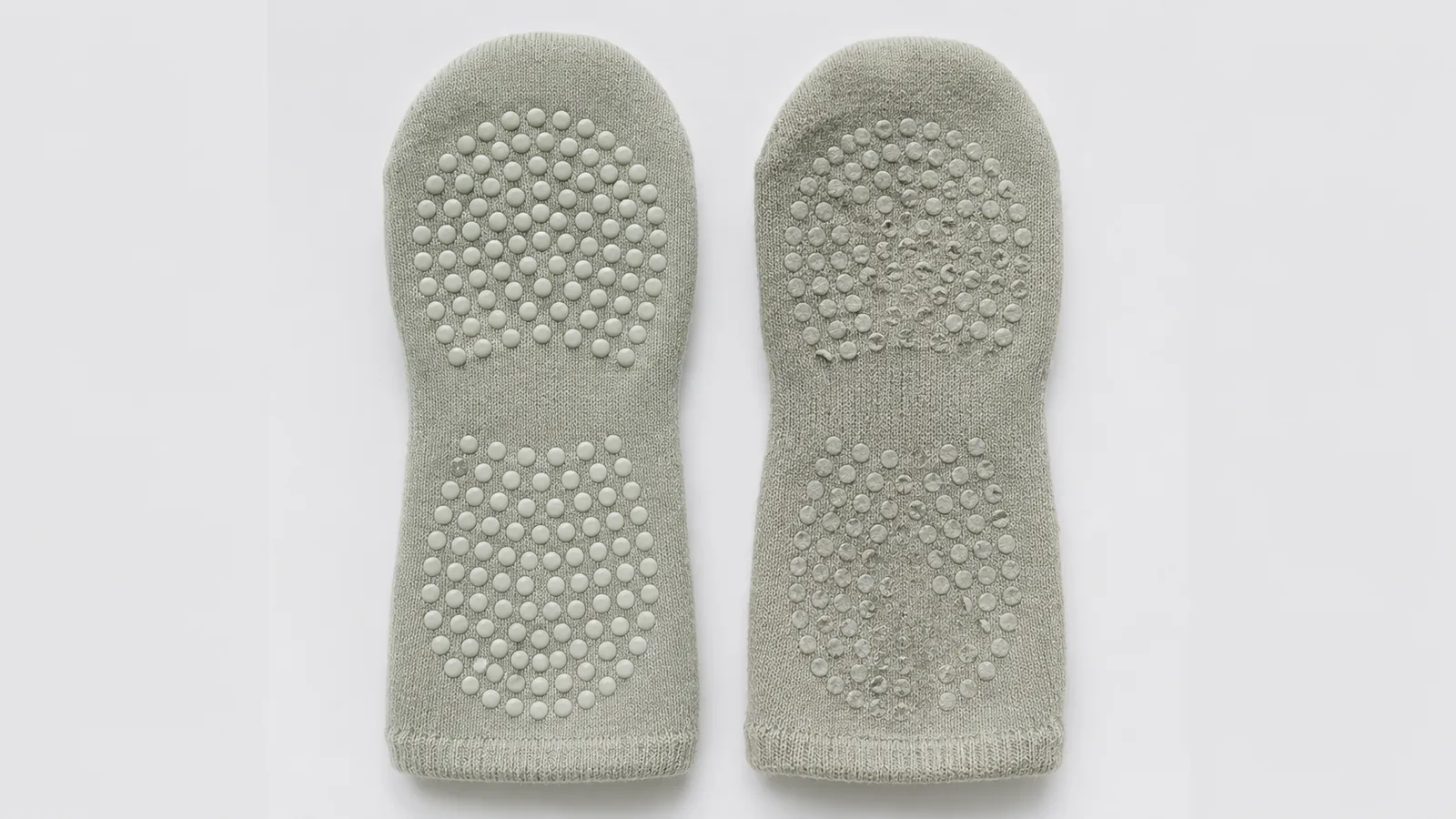
Grip sock lifespan depends on frequency, surface, fit, construction and care rather than a universal number of months or washes. Inspect the raised grip, cuff recovery and fabric condition, then follow the finished product's approved care label before deciding whether residue or physical wear is responsible.
Two users can reach different conclusions about the same product because service life changes with actual use and care. Rather than inventing an average, this guide explains the visible wear signs, factors that may accelerate them and a practical way to separate physical wear from a possible residue issue. For a deeper care diagnosis, use the guide to why grip socks can feel less grippy after washing.
Why There Is No Single Answer
Grip socks wear in three places at once, and each has its own clock.
The grip elements change through contact with floors, mats, footwear and laundering. Frequency, pressure and surface condition all affect the rate.
The fabric thins where pressure concentrates — the heel and the ball of the foot — and this depends on how the sock fits as well as how it is used. A sock that slides on the foot abrades faster than one that stays put.
The elastic in the cuff and sock body can lose recovery over repeated wear and washing. Care conditions outside the approved label may accelerate that change.
A pair reaches the end of its life when any one of those three gives out. That is why two people can buy the same socks on the same day and reasonably reach different conclusions about durability.
The Wear Signs That Mean It Is Time to Replace
Grip elements worn flat or missing
Run your fingers across the sole. New grip feels distinctly raised and catches against your skin. Worn grip feels smooth, low or polished, particularly under the ball of the foot and the heel where pressure concentrates. If whole elements have abraded away and left bald patches in the load-bearing zones, the sock has lost its function.
Grip cracked, flaking or lifting at the edges
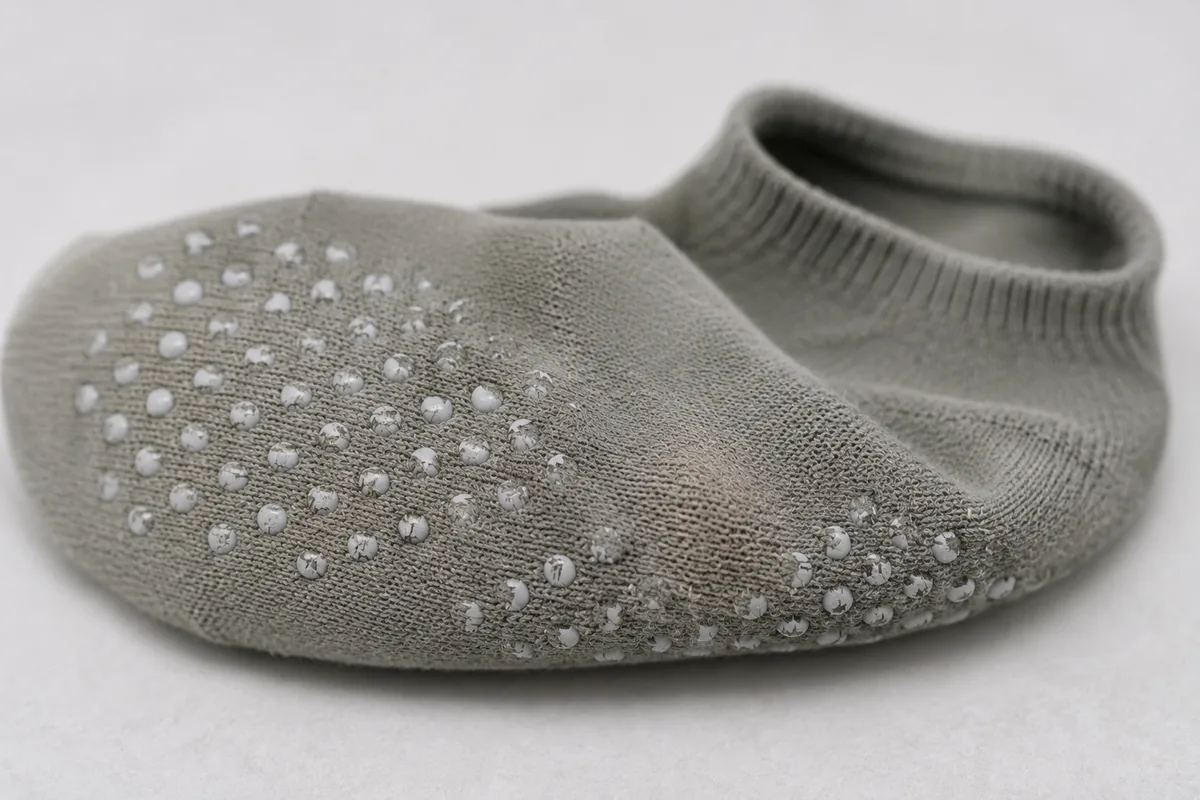
Cracks across grip elements, flaking or lifted edges show a physical change in the grip or its bond to the fabric. When this appears unexpectedly early under the approved care method, document the condition and review the product, application and care record with the seller rather than assuming normal wear.
Cuff no longer holds
If the sock slides down during use, or the cuff no longer springs back after being stretched, the elastic has gone. This matters more than it sounds — a sock that shifts on the foot moves the grip away from where it needs to be, so grip performance drops even if the grip itself looks fine.
Fabric thinning or holes
Hold the sock up to a light and look at the heel and the ball of the foot. Visible thinning, transparency or the beginnings of a hole mean the knit is at the end of its life regardless of grip condition.
Fit has changed permanently
If the sock has stretched so it no longer sits snugly, the grip pattern is no longer positioned under the loaded areas of your foot. This is a quiet failure mode that people often miss, because the sock looks intact.
Persistent odour that washing does not remove
This is not a direct grip-performance measure, but persistent odor after the approved wash process can be a practical retirement criterion for shared-use programs.
First, Rule Out Residue
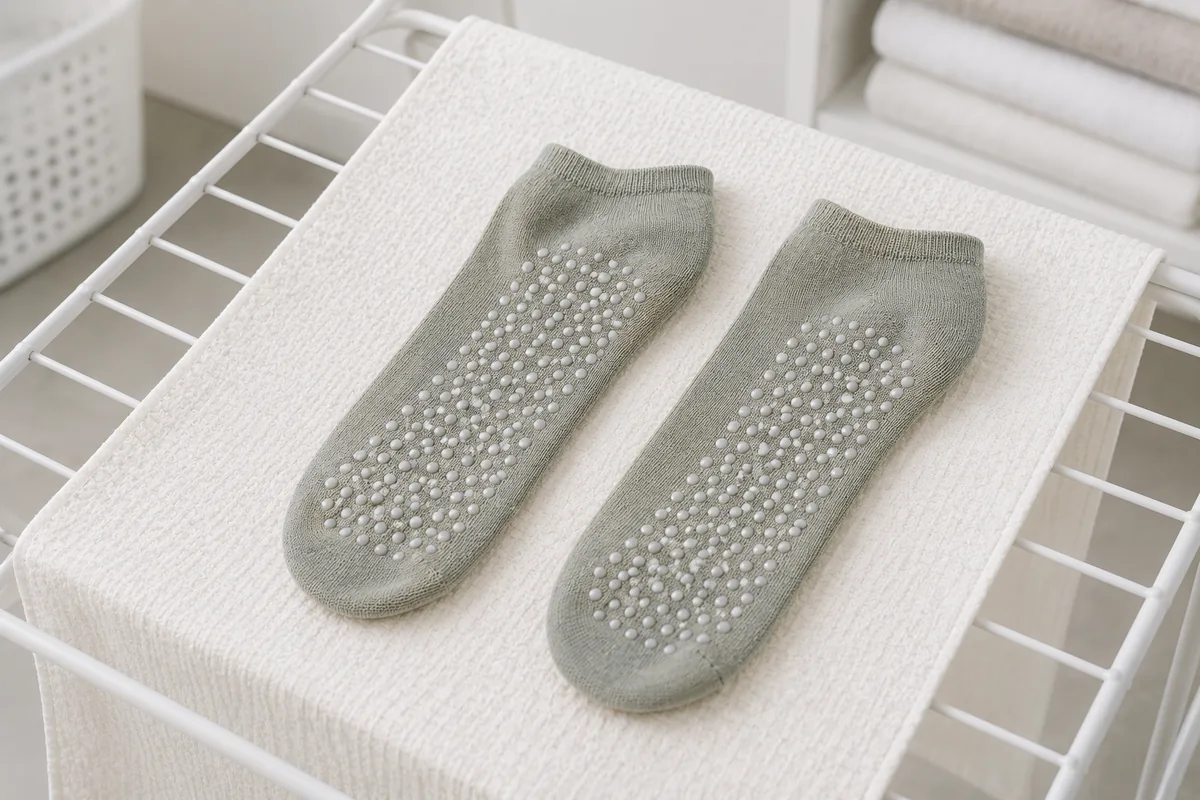
Before replacing a pair, inspect whether the grip is physically worn or still raised and intact. An intact surface may justify checking the recorded wash process and possible residue before treating the pair as finished.
Conditioning products, excess detergent or lint can leave material around the grip surface. The pair may feel different even when the raised elements remain physically intact.
Follow the product's care label. If the label permits a residue-removal rinse, rinse using the approved temperature and method, then dry fully as directed. Reinspect the sole after drying. A change after rinsing suggests residue may have contributed; visible flattening, cracks, lifted edges or missing elements point to physical wear or adhesion change.
A small number of washes alone does not establish the cause. Record the product, surface, wash and drying conditions, then compare the physical condition with an unused or approved reference.
What Can Shorten Grip Sock Life
| Factor | Shortens life | Extends life | Why |
|---|---|---|---|
| Drying method | Unapproved heat or tumbling | The method on the approved care label | Heat and mechanical action may affect yarn, elastic, grip or adhesion |
| Water temperature | Temperature outside the care instructions | The approved wash temperature | The response depends on the finished construction |
| Laundry products | Products or doses excluded by the care label | Approved products and doses | Residue may change the traction surface |
| Wash load | With towels, fleece, heavy mixed loads | Inside out, in a mesh bag, with light items | Reduces abrasion, snagging and lint pickup |
| Surface used on | Rough flooring, artificial turf, abrasive mats | Soft mats, smooth studio floors | Abrasion wears grip elements down mechanically |
| Fit | Loose socks that slide on the foot | Correctly sized, snug fit | Sliding increases abrasion and misplaces the grip |
| Rotation | Reusing a pair before it is fully dry | Allowing full drying between uses | Rotation can provide enough drying time |
| Build quality | Grip or knit outside the approved specification | A physical sample approved against written checkpoints | Construction, application and coverage affect the wear pattern |
How to Care for a Pair
The finished product's approved care label is the primary instruction.
Use only the permitted wash temperature, cycle, products and drying method. When the label allows machine washing, a mesh bag and a lighter load may reduce rubbing and lint pickup. Do not add softener, dryer sheets, high heat or tumble drying unless the approved instructions permit them.
Fit also matters: a sock that slides can abrade and move the grip away from the intended zones. Allow each pair to dry fully before reuse. The grip sock sizing guide explains how heel placement and size range affect position.
Replacement Guidance by Use Case
Individual users
Inspect rather than relying only on a calendar. Check whether the grip elements remain raised, the cuff still recovers and the heel fabric remains intact. Compare with a newer pair when possible and retire the pair when it no longer meets the user's fit, traction or condition needs.
Pilates and yoga studios
If you rent or lend socks, build inspection into the documented laundry routine. Remove pairs with flattened, cracked, lifted or missing grip in the loaded areas and apply the same recorded retirement criteria to every pair. Studios developing a product can connect care wording with the Pilates and yoga grip sock program.
Football clubs and academies
Boot friction, surfaces and team laundry can create a different wear profile from studio use. Give the kit team the approved care instructions, inspect the set at agreed intervals and replace by condition rather than assuming every pair lasts the same number of sessions or a full season.
Trampoline parks and indoor venues
If the venue launders and reuses socks, define sorting, care, inspection and retirement rules. Check grip edges and loaded zones during sorting. Selling and reusing are different operating models; compare hygiene requirements, labor, storage, guest expectations and product policy through the trampoline park operator guide. Studios can apply the same rules through a bring, buy or borrow sock policy.
If You Are Sourcing Grip Socks
Durability expectations should be defined before production instead of expressed as an unsupported universal promise.
Grip application, coverage, compatibility, knit construction, fit and care can all affect the result. GripSockFactory's confirmed base sample review covers design, dimensions, stitching and overall sock quality. Edge, flex, wash or other performance methods must be agreed separately when a project requires them. Use the guide to define optional grip adhesion checks and record the method and acceptance point.
Grip coverage, yarn choice, cuff construction and fit should be reviewed together. Inspect a physical sample on the intended surface and compare it with the written specification instead of relying on a general durability label.
Put the approved care guidance on the product and packaging, and give the same instructions to clubs or venues laundering in volume. Keep the approved sample, care wording and any project-specific check record together for repeat orders.
Frequently Asked Questions
How long do grip socks last?
There is no fixed answer, because lifespan depends on how often they are worn, the surfaces involved, how well they were made and how they are washed. Judge by wear signs instead: replace when grip elements are worn flat, cracked or missing, when the cuff no longer holds, or when the fabric thins at the heel or ball of the foot.
When should I replace my grip socks?
When the grip no longer feels raised under the ball of the foot and heel, when grip elements are cracking or lifting, when the cuff has lost its recovery, or when the fabric is thinning or holed. Any one of these ends the pair's useful life.
My grip socks feel slippery — are they worn out?
Not necessarily. First inspect for flattened, cracked, lifted or missing elements. If the grip remains raised and intact, review the care record and follow any residue-removal step permitted by the product label before testing again after full drying.
Does washing ruin grip socks?
Approved laundering is part of normal use, but conditions outside the care label may affect yarn, elastic, grip or adhesion. Follow the finished product's specified temperature, cycle, products and drying method.
Can grip socks be repaired or the grip reapplied?
Home reapplication is not a reliable way to restore the approved product. Once grip elements have abraded away or separated, retire the pair and review unexpected early failure with the seller.
How many pairs of grip socks should I own?
Own enough pairs for each to be cleaned and dried fully according to the care label before reuse. The number depends on training frequency and laundry schedule.
Is grip peeling after a few washes normal?
Unexpected early peeling under the approved care method warrants review. Document the number of uses, surface, wash process and physical condition, then compare the pair with the approved reference and discuss it with the seller.
Do more expensive grip socks last longer?
Not automatically. Price alone does not verify service life. Compare construction, fit, grip coverage, physical sample condition, care guidance and any agreed project-specific test evidence.
Need a Grip Sock Sample with Clear Checkpoints?
Send the intended use, surface, size range, grip direction, quantity, market and required review method. We will confirm the practical sample scope, including any separately agreed edge, flex or wash evaluation, before bulk production.
Request a Sample & Quote